2026/01/27(Tue) 14:00 -16:00 一樓演講廳 1F, Auditorium
Title
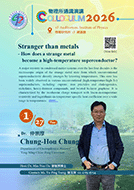
Stranger than metals - How does a strange metal become a high-temperature superconductor?
Speaker
仲崇厚教授 (國立陽明交通大學電子物理系) Prof. Chung-Hou Chung (Department of Electrophysics, National Yang Ming Chiao Tung University)Abstract
A major mystery in condensed matter systems over the last four decades is the microscopic origin of the strange metal state from which unconventional superconductivity directly emerges by lowering temperatures. This state has been widely observed in various unconventional (high-temperature/high-Tc) superconductors, including: cuprate, iron pnictides and chalcogenides, nickelates, heavy-fermion compounds, and twisted bi-layer graphene. It is characterized by the incoherent charge transport with linear-in-temperature resistivity and logarithmic-in-temperature specific heat coefficient over a wide range in temperatures. Whether these strange metal phenomena observed in different materials share a common origin is an outstanding open problem. The microscopic mechanism for this state challenges our understanding of how ordinary metals conduct electricity. In these strange metals, electrons lose their individual identities, acting collectively in a “soup”, in which all particles are connected through quantum entanglement. The most intriguing class of strange metal is the “Planckian metal phase”, showing quantum critical ħω/kBT scaling in AC scattering rate and universal linear-in-temperature DC scattering rate: 1/τ = αP kB T / ħ with a universal constant prefactor αP ~ 1 as well as logarithmic-in-temperature singular specific heat coefficient. It has been observed in various high-Tc cuprate superconductors over a finite range in doping near optimal doping [1]. Revealing the mystery of the Planckian metal state is believed to be the key to understanding the mechanism for high-Tc superconductivity in cuprates, a long-standing puzzle. Here, we propose a generic microscopic mechanism for this state based on quantum-critical local bosonic charge Kondo fluctuations coupled to both spinon and a heavy conduction-electron Fermi surfaces within the heavy-fermion formulated slave-boson t-J model [2]. A closely related idea proposed by C.H. Chung and collaborators based on critical charge fluctuations near Kondo breakdown quantum critical point has been used to account for quantum critical strange metal states observed in various heavy-fermion compounds [3]. Our approach is motivated by the striking similarity in strange metal phenomenology between cuprates and heavy-fermion Kondo lattice systems. By a controlled perturbative renormalization group analysis of our effective heavy-fermion model, we examine the competition between the pseudogap phase, characterized by Anderson’s Resonating-Valence-Bond spin-liquid made of fermionic spin-singlet spinons, and the Fermi-liquid state, modeled by coherent electron hopping (effective charge Kondo hybridization). We find an extended quantum-critical metallic phase with a universal Planckian ħω/kBT scaling in scattering rate near a localized-delocalized (pseudogap-to-Fermi liquid) charge-Kondo breakdown transition. The d-wave superconducting ground state emerges near the transition. Unprecedented qualitative and quantitative agreements are reached between our theoretical predictions and various experiments, including optical conductivity [4], universal doping-independent field-to-temperature scaling in magnetoresistance [5], singular specific heat coefficient [6], marginal Fermi-liquid spectral function observed in ARPES [7], and Fermi surface reconstruction observed in Hall coefficients in various overdoped cuprates [5,8]. Our mechanism offers a microscopic understanding of the quantum-critical Planckian metal phase observed in cuprates and its link to the pseudogap, d-wave superconducting, and Fermi liquid phases. It provides a promising route for understanding how d-wave superconductivity emerges from such a strange metal phase in high-Tc cuprates–one of the long-standing open problems in condensed matter physics since 1990s. It also shows a broader implication for the Planckian strange metal states observed in other correlated unconventional superconductors.
References:
[1] A. Legros et al., Nat. Phys. 15, 142 (2019).
[2] Yung-Yeh Chang, Khoe Van Nguyen, Kim Remund, and Chung-Hou Chung*, Rep. Prog. Phys.
88, 048001 (2025) https://doi.org/10.1088/1361-6633/adc330 . (Editor’s Pick, Highlighted in “Physics World”)
[3] J. Wang et al., PNAS 119, e2116980119 (2022); Yung-Yeh Chang et al., Phys. Rev. B 97, 035156
(2018); Yung-Yeh Chang et al., Phys. Rev. B 99, 094513 (2019); Yung-Yeh Chang et al., Nature
Communications, 14, 581 (2023).
[4] B. Michon et al., Nature Communications 14, 3033 (2023).
[5] J. Ayres et al., Nature 595, 661 (2021).
[6] B. Michon et al., Nature 567, 218 (2019).
[7] S.D. Chen et al., Science, 366, 1099 (2019).
[8] C. Proust et al., Annual Review of Condensed Matter Physics 10, 409 (2019).
Abstract
Language
演講語言 (Language): in English