


Revival of Majorana Zero Modes in Imperfect Superconducting Devices
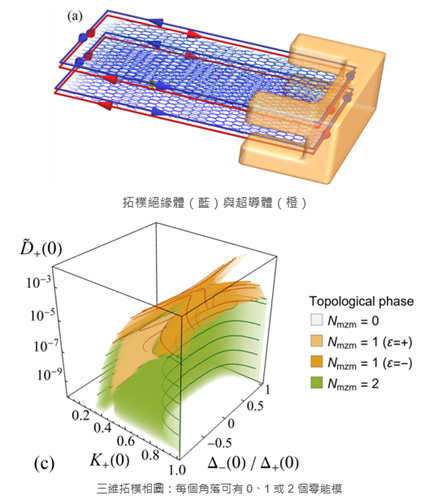
Disorder and nonuniformity are usually viewed as obstacles to topological superconductivity. A theoretical study by Anna Ohorodnyk and Dr. Chen-Hsuan Hsu at the Institute of Physics, Academia Sinica, shows that these imperfections can also enable new topological phases. The team studied two parallel helical edge channels in contact with a superconductor, combining analytical calculations with renormalization-group analysis to examine electron interactions, channel asymmetries, and random spin-flip scattering. Spin-flip scattering separates the conditions for the two Majorana zero modes, allowing an additional phase with a single mode at each corner. When the channels have unequal pairing or interaction strengths, tuning electron interactions can drive a cascade of topological transitions in which a mode disappears and reappears. Under suitable conditions, disorder can also induce a topological phase in a system that is trivial in the clean limit. The results identify a possible route to electrical control through screening of electron interactions and provide guidance for realizing topological superconductivity in realistic devices. This work has been published in Physical Review B.
Journal Links: https://doi.org/10.1103/5cgn-yll2
WebSite: https://journals.aps.org/prb/abstract/10.1103/5cgn-yll2