Research > Expertise
Optical Sum Frequency Generation (SFG) Spectroscopy
SFG spectroscopy is an interface-specific analytical method. This nonlinear laser spectroscopy was developed in 1987 and rapidly applied to deduce the composition, orientation distribution, and structural information of molecules (or lattices) at surfaces/interfaces. In a typical SFG setup, two laser beams mix at a surface and generate an output beam with the frequency equal to the sum of the two input frequencies. Such SFG process is dictated by material symmetry and, thus, offers an opportunity to probe a surface/interface where the symmetry is broken with respect to their bulk counterpart. Besides interface specificity, SFG spectroscopy has advantages in its ability for monolayer surface sensitivity, accessibility to buried interfaces, in situ remote detection, and can be integrated with microscopy or time-resolved spectroscopy to achieve high spatial and temporal resolutions.
Phase-Sensitive (PS-) and Time-Resolved (Tr-)SFG spectroscopy
SFG process is governed by second-order nonlinear optical susceptibility, χ(2), of the materials, which is a complex quantity. In analogous to absorption spectrum in linear optics, imaginary part of χ(2) allows better characterization of resonances of an interface. Sign of Imχ(2) can also indicate the net polar orientation of molecules, providing microscopic configurational information of an interface. Technically, one requires PS-SFG spectroscopy to measure phase of SFG for deducing the complex χ(2). Besides the steady-state properties, one can further explore dynamics of an interfacial system on the femtosecond timescales by utilizing time-resolved (Tr-)SFG spectroscopy.
Our Home-built PS-SFG and momentum-dependent SFG spectroscopy
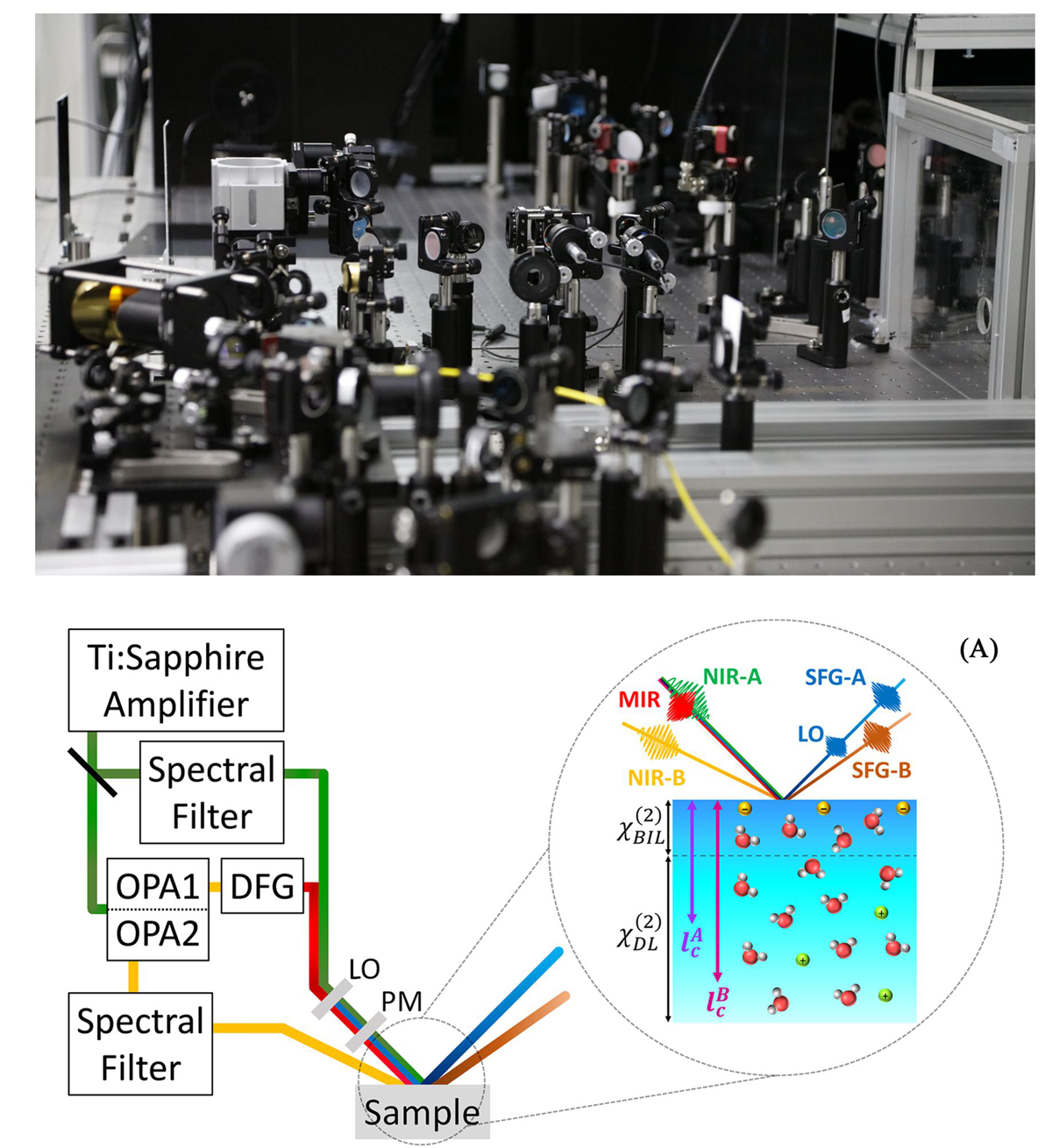
Vibrational SFG signals from a liquid interface are typically 1-10 photons per laser shot. To measure phase of such weak radiations from a vibrating liquid surface, we develop a PS-SFG spectroscopy with the common-path scheme. The light source is a 1-kHz, 50-fs Ti:sapphire laser, combined with an optical parametric amplifier (OPA) and a difference frequency generator (DFG). The generated mid-IR and near-IR beams (bandwidths of ~400 and ~15 cm-1, respectively) propagate collinearly through a reference quartz crystal acting as a local oscillator and a dispersive medium for phase modulation, and finally impinge on the sample. The SF signal generated from the sample in reflection interferes with the reference SF signal also reflected from the sample and creates an SF spectral interferogram that provides amplitude and phase information of the complex χ(2). A polychromator with a charge-coupled device is used for multiplex detection of a broadband spectrum. This system allows phase measurements with precision and reproducibility better than 3 degrees, and sensitivity of the amplitude measurement better than10-22 m2V-1。To further separate the surface second-order and bulk third-order contributions, we developed a momentum-dependent SFG scheme where multiple SFG spectra are measured with different phase mismatches. See Science Advances 9, eadg2823 (2023) for details.
Terahertz photonics and spectroscopies
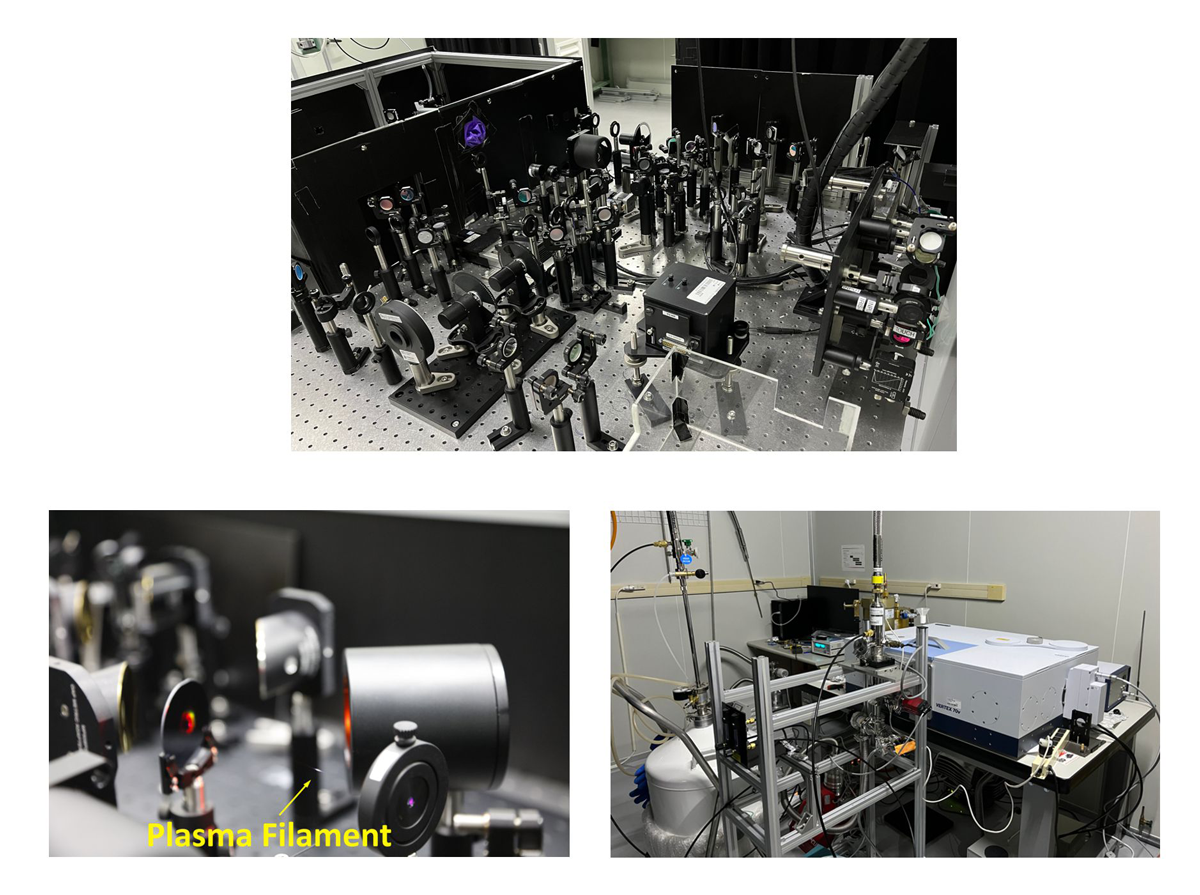
THz spectral range (0.4 ~ 40 meV) is a fertile ground for spectroscopic research, where many fundamental excitations in condensed matters can be explored, such as lattice vibrations (phonons), superconducting gaps, spin quasiparticles, and many others. In Wen group at IoP/AS, we conducted related studies with THz time-domain spectroscopy, THz emission spectroscopy, THz pump-probe spectroscopies, and broadband Fourier-transform infrared spectroscopy, with selected sources (THz photoconductive antenna, optical rectification, and two-color filamentation in air) and detection schemes (electro-optic sampling or air-biased-coherent-detection). If you'd like to learn more about our research, please contact Dr. Yu-Chieh Wen.