Novel Materials Graphene-based Electronics Unconventional Nanofabrication Technique
Armed with a state-of-art dilution fridge system, we are capable of performing transport measurement in extreme conditions at temperature as low as 15 mK and magnetic field up to 17 Tesla where new phenomena and new physics can be revealed. The systems currently under investigation are transition metal oxide, strongly correlated electronic system, multi-ferroics, topological insulator...etc.
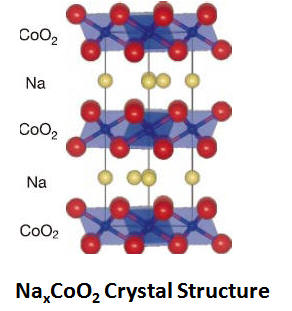
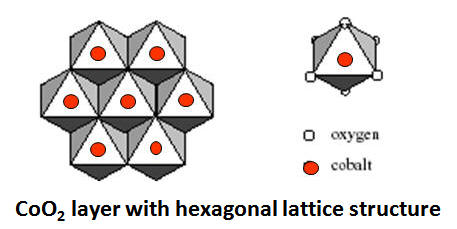
Taking sodium cobaltate NaxCoO2 as an example, it was first noted for the discovery of superconductivity when intercalated with water in 2003. It consists of 2D CoO2 layer with hexagonal lattice spaced by Na ions. By tuning the Na content x, its magnetic and transport properties change dramatically revealing its strongly correlated nature. In high Na content, unusual field-dependence and also enhanced magnitude in thermopower were unveiled by Ong's group at Princeton, where spin-entropy mechanism may play a role. More recently, several new stable phases with specific x values were identified by Chou's group at CCMS NTU to arise from different superstructure in Na layer. We have close collaboration with Dr. Chou's group to further explore the influence of Na superstructure on its physical property.
More highlights are coming soon...
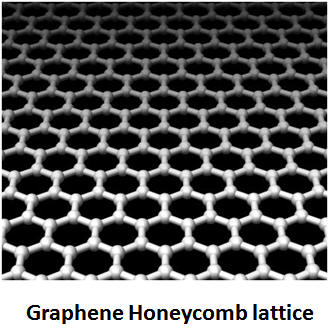
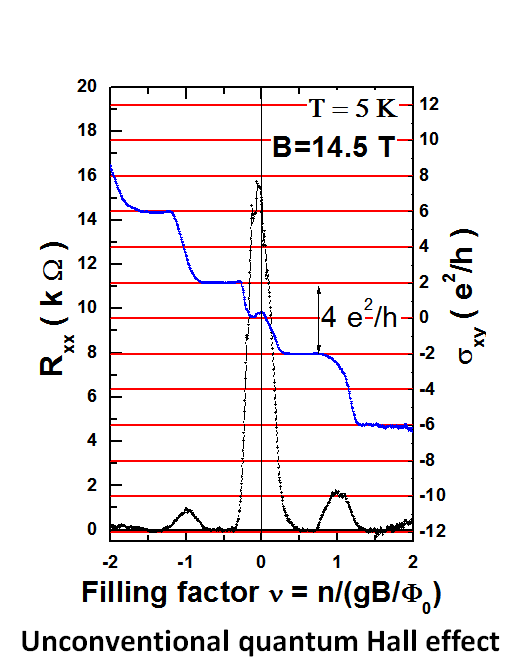
Graphene comprises a single atomic layer of carbon sheet. In its honeycomb lattice structure, electron loses all its mass traveling at a speed of 300 times smaller than c (the speed of light) obeying Dirac equation. Even though electron becomes massive in a bi-layer graphene, the chiral fermionic excitations remain present in both single-layer and bi-layer graphene. There are two well-defined values of "chirality"(projection of pseudo-spin state on the propagation direction) resembling the "helicity" in particle physics but not only being limited to massless particles. Many novel transport phenomena have been reported, where the chiral fermionic property plays an important role. In addition, graphene-based electronics may be a promising candidate for the next generation electronics.
We have developed a scheme to prepare micron-sized few-layer graphene crystals. Several issues related to the transport in quantum Hall regime are currently under investigation. We are also working on several other graphene-based device to further explore the special transport phenomena resulting from the chiral fermions.
Highlights: Demonstration of Field-Effect Thermoelectricity More are coming soon...
In conventional nanofabrication tools, resist and chemicals are needed and may degrade the quality of deposited thin film. We, therefore, intend to develop a technique for resist-free fabrication of nano-device such that the quality of thin films and also interfaces can be improved. This would be important for the study in spin-electronics devices. More highlights are coming soon...
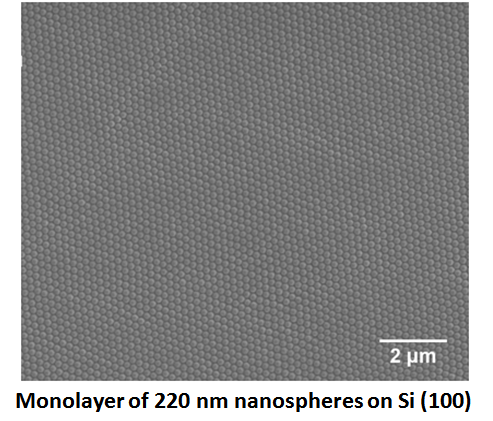
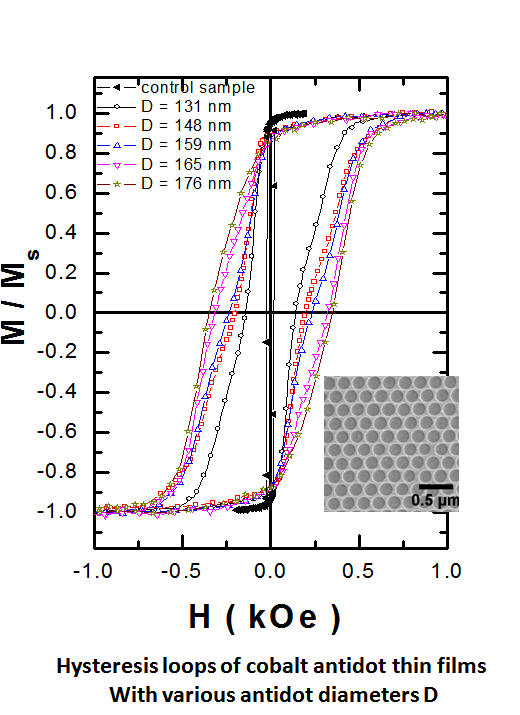
We are also developing a technique to fabricate large area periodic nanostructured system at lower cost and better time efficiency. We utilized a special polymer bridging effect to prepare large area (more than 1 cm x 1 cm) monolayer of close-packed polystyrene nanospheres with various diameter ranging from 100 nm to 1um. It can then be used as a template to fabricate large area nanostructured system. From a series of cobalt antidot thin film samples prepared by this technique, we found an interesting crossover behavior in the magnitization reversal when tuning the antidot diameters. In addition, we also uncovered that the effective moment per cobalt atom is marching down as the surface to bulk volume fraction increases. This work is a collaboration with Dr. Keng-Hui Lin and Dr. Wen-Tau Juan at IoP AS.
Highlights: Fabrication of monolayer polymer/nanosphere hybrid at a water-air interface More are coming soon...