


Supernova Gravitational Waves as a Probe of Physics Beyond the Standard Model
Core-collapse supernovae are the violent explosions of massive stars at the end of their lives. They are powerful sources of neutrinos and gravitational waves, though the latter are yet to be detected due to their transient nature and the inherent stochasticity. The neutrinos are produced inside the emerging neutron star. Their emission dominates the cooling of the (proto-)neutron star. Just outside of it they are the driving factor to turn the implosion into an explosion. Within the neutron star the neutrino number density becomes so high that neutrino self-interactions beyond the Standard Model of particles could induce flavor conversion. The neutrino flavor is a quantum mechanical quantity that can be thought of as a way to discriminate between different kinds of neutrinos, which interact with normal matter at different strengths. Using numerical simulations of core-collapse events an international collaboration led by Academia Sinica postdoctoral researcher Dr. Jakob Ehring showed that such flavor conversions inside the neutron star could lead to a detectable signature in the gravitational wave signal of core-collapse events. The conversion of the neutrino flavor leads to enhanced heating which in turn stirs convection inside the neutron star. The convection excites oscillations in the outer layers of the neutron star, which emits gravitational waves. The gravitational wave signal is large in amplitude but spans a broad frequency range. It can nevertheless be separated from other signal components because the burst appears during an otherwise quiescent phase of the supernova’s gravitational wave emission. To have a precise timing the signal can be combined with measurements of the neutrino emission. Thus combining the two different astrophysical messengers it becomes possible to indirectly probe physics beyond the standard model. The work does not focus on a specific flavor conversion scenario. It rather shows for the first time that gravitational waves can be utilized to probe neutrino properties beyond the standard model. The results highlight the potential of multi-messenger astronomy to test particle physics under extreme astrophysical conditions.
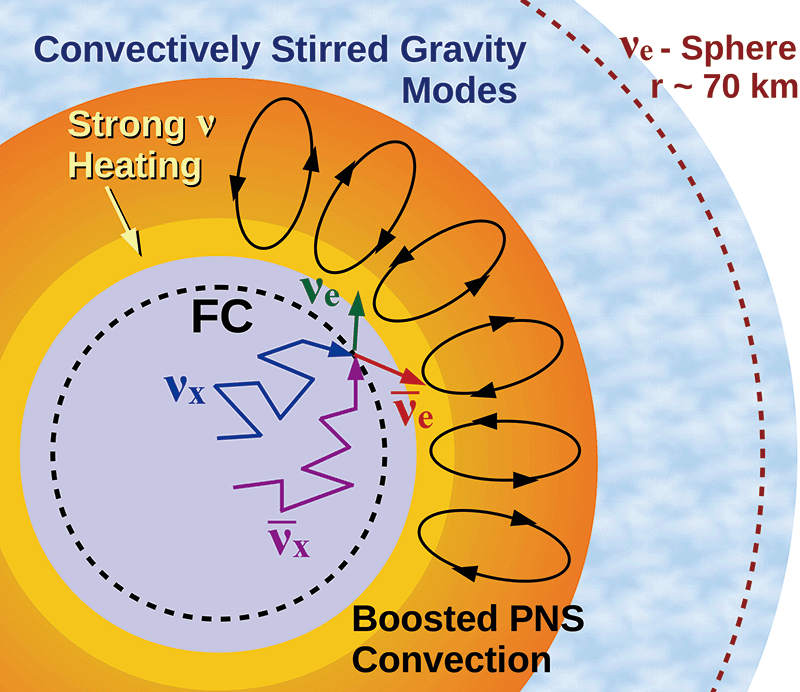
Figure 1: A schematic overview of enhanced convection inside the proto-neutron star (PNS) caused by neutrino (ν) flavor conversions (FC). The subscripts indicate different neutrino flavors.
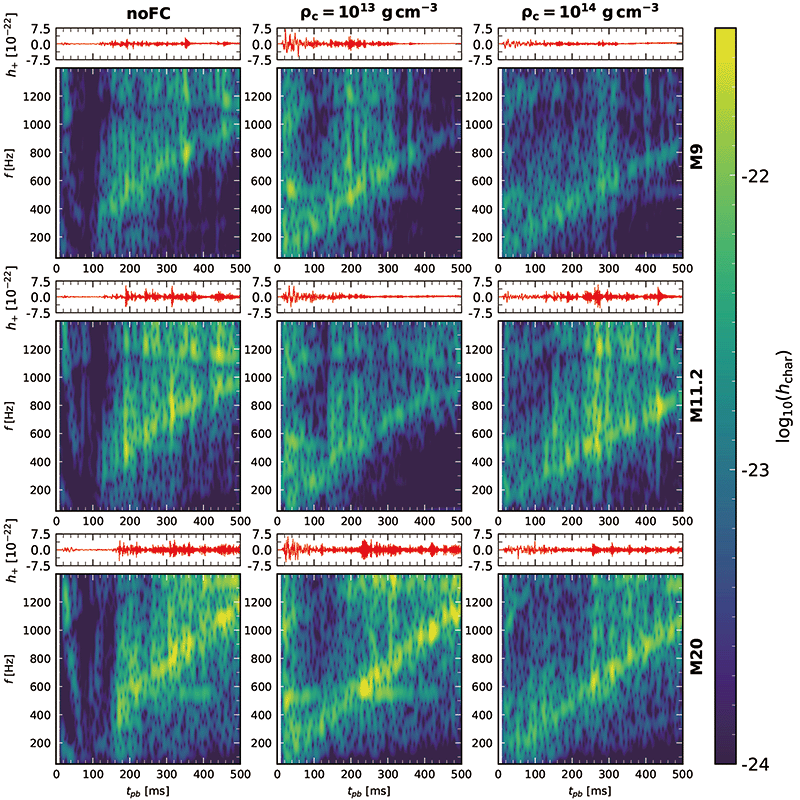
Figure 2: Amplitudes and spectrograms of the gravitational wave signal obtained from numerical simulations. The different rows correspond to stellar progenitors of varying masses. The left column shows simulations without neutrino flavor conversion, while the two right columns represent scenarios where flavor conversions occur at different locations inside the neutron star. The horizontal axis indicates time after core bounce, and in the spectrograms the vertical axis indicates frequency. In the left column, the vertical blue band signalizes the quiescent phase shortly after core-bounce, which is absent in the other models. The time of core-bounce can be independently determined from the measurement of neutrino emission.

期刊連結: https://doi.org/10.1103/rv17-jm6g