


New Frontier in the Search for Feebly Interacting Particles with Circumstellar Medium of Supernovae
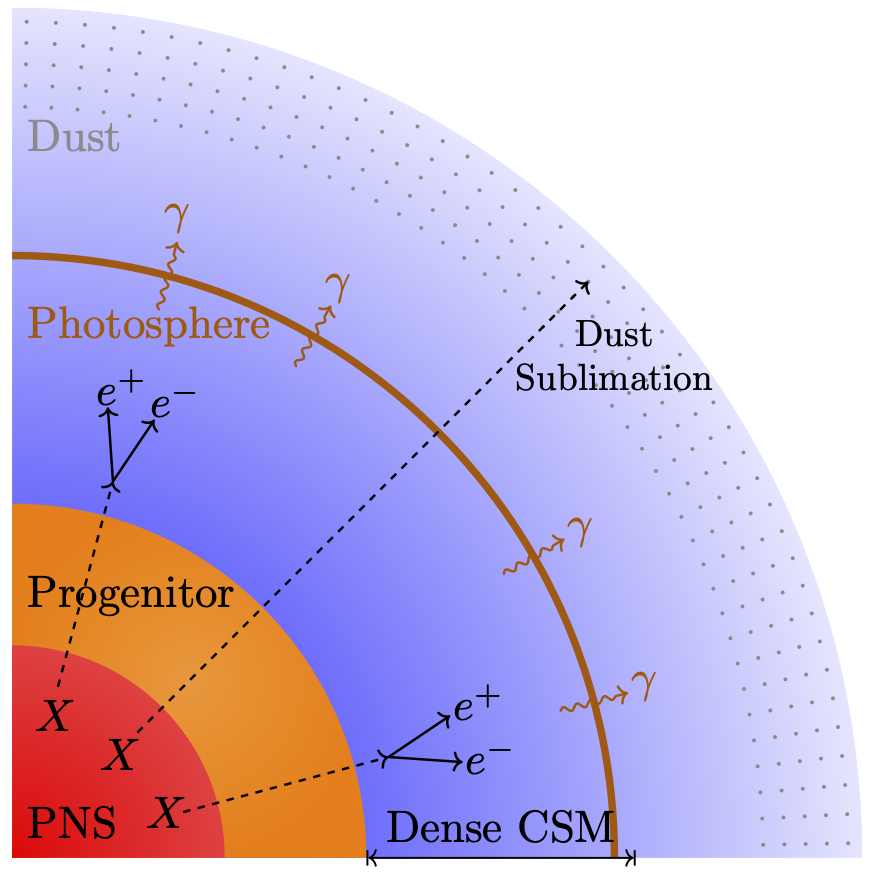
Supernovae have long served as powerful laboratories for new physics. Dr. Yen-Hsun Lin and Dr. Meng-Ru Wu of the Institute of Physics, together with collaborators in Korea [Dr. Yu Cheng (KAIST), Dr. Chui-Fan Kong (IBS), and Prof. Seokhoon Yun (KNU)], propose using the circumstellar medium of supernovae, the material ejected by the progenitor before it explodes, as a new playground for probing feebly interacting particles. Such particles, dark photons for example, can be produced during core collapse and propagate outward, injecting energy into the circumstellar medium through their decays into electron-positron pairs. This heats the medium and makes it glow, and even sublimates the surrounding dust, producing a distinctive precursor signal before the supernova shock breakout. Using observations of SN 2023ixf in the Pinwheel Galaxy, the research team establishes stringent new constraints on dark photons and explores regions of parameter space beyond the reach of previous bounds. This work is the first to systematically develop the circumstellar medium as a tool for exploring new physics, opening an avenue distinct from conventional probes. The next Galactic supernova will offer a unique opportunity to search for traces of physics beyond the Standard Model. This research was published in Physical Review Letters in September 2026.
Journal Links: https://link.aps.org/doi/10.1103/8v59-c52b