


Six-state clock physics in an atomically thin antiferromagnetic
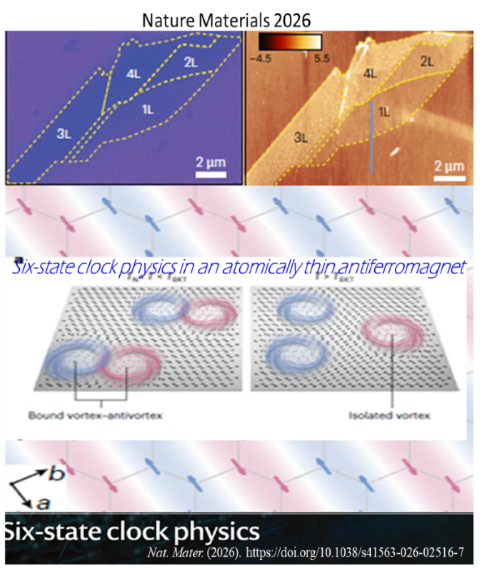
Dr. Raman Sankar and Prof. Shang-Fan Lee (Institute of Physics, Academia Sinica), in collaboration with Prof. Xiaoqin Li, Prof. Allan H. MacDonald, and Prof. Edoardo Baldini (Department of Physics and Center for Complex Quantum Systems, The University of Texas at Austin, USA), have experimentally realized the long-predicted phenomenon of clock magnetism in an atomically thin van der Waals crystal an important breakthrough recently reported in Nature Materials. Clock magnetism, originally formulated within theoretical clock model Hamiltonians, describes a magnetic phase in which electron spins are confined to a discrete set of symmetry defined orientations, rather than rotating continuously as in conventional ferromagnets or antiferromagnets. Although predicted decades ago, its realization in a real material had remained elusive due to the stringent requirements of crystalline symmetry, strong magnetic anisotropy, and reduced dimensionality needed to stabilize such discrete spin configurations.
In this work, the team engineered and systematically characterized an atomically thin layered material in which crystal symmetry and spin orbit coupling cooperate to enforce multiple energetically equivalent spin orientations. The two dimensional nature of the crystal is essential: reduced dimensionality enhances anisotropic exchange interactions while suppressing competing magnetic fluctuations, thereby stabilizing the clock-ordered state. Comprehensive structural and magnetic measurements confirmed the presence of discrete spin directions, providing compelling experimental validation of long-standing theoretical predictions.The realization of clock magnetism carries profound fundamental and technological implications. From a basic science perspective, it demonstrates that symmetry protected discrete spin states can emerge in real low-dimensional materials, opening new avenues to explore domain-wall dynamics, collective excitations, and potentially topological magnetic phenomena. From an applications standpoint, clock ordered states enable multi-level spin configurations beyond binary encoding, offering promising routes toward higher density information storage and energy efficient spintronic devices. Their discrete symmetry may also facilitate robust magnetic switching and novel magnetoelectric coupling mechanisms.
Future investigations will focus on stabilizing related Berezinskii Kosterlitz Thouless (BKT) phases at progressively higher temperatures, potentially approaching room temperature. Beyond NiPS3, this discovery suggests that a broad family of two dimensional magnetic materials may host previously unexplored symmetry driven phases. Overall, this work highlights the power of modern quantum materials design, where precise control of crystal growth, symmetry, and magnetic interactions enables the realization of once purely theoretical phases of matter and significantly expands the frontier of two dimensional magnetism and quantum functional materials.
Journal Links: https://doi.org/10.1038/s41563-026-02516-7