


Topological Surface Superconductivity via Josephson Coupling in Bi2Te3/Nb films
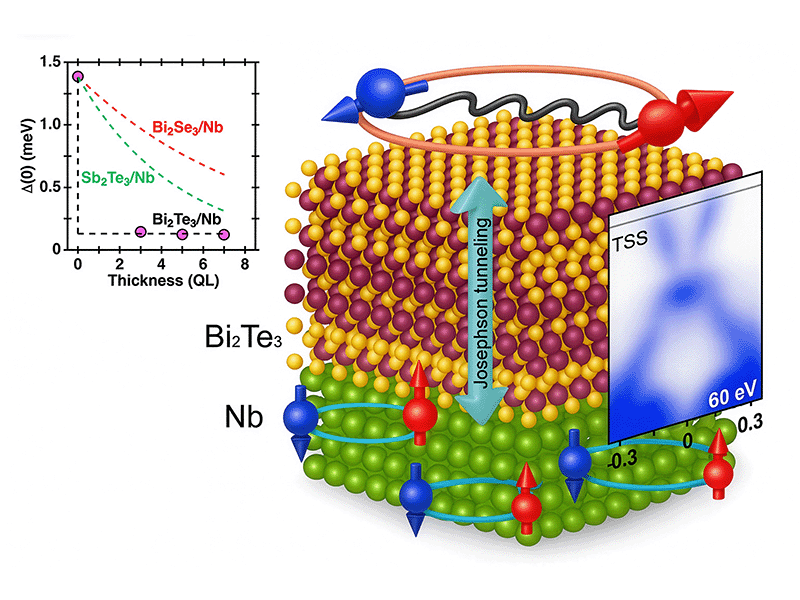
Josephson junctions incorporating superconducting topological surface states (TSS) emerge as promising building blocks for next-generation superconducting qubits, offering a potential pathway towards improved coherence for quantum computing. However, in most experiments, Josephson coupling is often obscured by other proximity effects associated with bulk carriers. In this work, we demonstrate such a junction using a topological insulator Bi₂Te₃ film epitaxially grown on a superconducting Nb substrate. Cooper pairs from Nb tunnel through the insulating Bi₂Te₃ layers and induce superconductivity in the TSS via Josephson coupling. Using scanning tunneling microscopy at T = 0.3 K, we observe a clear superconducting gap in the TSS of Bi₂Te₃. The induced gap (~1/10 of that of Nb) remains nearly constant as the Bi₂Te₃ film thickness increases, even though the superconducting pair density decreases exponentially. These observations can be understood via Josephson pair tunneling through the nearly insulating Bi2Te3 bulk, creating a pure topological superconducting sheet. Our findings underscore the essential role of Josephson coupling for long-range pairing in the spin-helical Dirac Fermions of topological structures.
This research is the result from the international collaboration between Dr. Tien-Ming Chuang’s group (Institute of Physics, Academia Sinica) and Prof. Tai-Chang Chiang’s group (University of Illinois Urbana-Champaign). The work at the Institute of Physics was supported by the National Science and Technology Council and Academia Sinica. The paper was published in Nano Letters 25, 16387 (2025).
Journal Links: https://doi.org/10.1021/acs.nanolett.5c04230