Intermediate and High Energy Physics Research Group
(1). Theory Programs
The ulimate goal of theroretical particle physics research is to discover the fundamental structure of matter. Developments of the theory will depend not only on the self consistency of the theory itself but also hints and directions from experimental data from experiments in accelerators like, LHC, RHIC... , and particle astrophysics and cosmology. In the following, we enlist our research topics in three major categories according to the nature of their corresponding experimental data.
A. Particle Phenomenology
- Higher-order calculations in kT factorization
- Jet substructure in colliders
- Resolving B-CP puzzles in QCD Factorization
- Scalar and pseudoscalar glueballs
- Radiative decays of B mesons
- Scalar mesons in D decays
- Quantum gravity
- Nonperturbative bound on high multiplicity cross sections in theory in three dimensions from lattice simulation
- Neutrino mass and neutrino oscillation
- Quantum bit commitment
- Quantum teleportation
- Application of Statistical Physics Methods to Social and Economic Systems
B. Particle Astrophysics and Cosmology
- Decaying superheavy dark matter and subgalactic structure of the Universe
- Bound on the time variation of the fine structure constant driven by quintessence
- Observational strategies of CMB temperature and polarization experiments
- Density perturbation in inflationary universe
- Correlated hybrid fluctuations from inflation with thermal dissipation
- Off-equilibrium dynamics of the primordial perturbations in the inflationary universe
C. Theoretical Nuclear Physics
- Cascade production in heavy-ion collisions at SIS energies
- Two-level model and magnetic field effects on the hysteresis in n-GaAs
(2). Experimental Nuclear Physics
We have an on-site facility of 3 MV (NEC 9SDH-2) tandem accelerator which was installed in 1989. Since then the accelerator became an important facility for experimental research in accelerator based atomic and applied physics. The accelerator system has two negative ion sources, SNICS for solid source material and Alphatross for noble gases Helium-3 and Helium-4, capable of producing a wide range of ion beam species. The ion-beams for a given charged (q) state with a maximum energy E = 3(q+1) MeV can be obtained and selected by an analyzing magnet to meet experimental need. There are three beamlines available with different scattering chambers for various research needs(i.e. ion-solid interaction, Rutherford backscattering, Particle induced X-ray emission, ion irradiation, etc.), especially the newly-installed Oxford micro-beam system (Fig. 1). We have made the accelerator available for outside users. Every year a fraction of the machine time was provided to people of domestic institutions such as Institute of Atomic and Molecular Sciences, Academia Sinica, National Taiwan University and National Sun Yat-sen University.
.
As for the high energy nuclear experiment, we participate at two international projects: SPring-8 LEPS experiment (Fig. 2) and BNL PHENIX experiment (Fig. 3). Photon beam with maximum energy up to 2.5 GeV can be generated from the backward Compton-scattering of incident eV laser photons with 8 GeV electrons circulating inside the storage rings of synchrotron facility, SPring-8 in Japan. We study the mechanism of non-perturbative interactions between photon and quarks at a few GeV via the reconstruction of γN→fN reaction. In the future, we will produced solid polarized HD target under the condition of 17-Tesla magnetic field and 15-mK low temperature. With the usage of 2.5 GeV linearly polarized photon beam, double polarization quantities will be measured for the investigation of strangeness content in the nucleon. In Brookhaven National Lab, U.S., RHIC collider can crate a collision of Au nuclei of center of mass energy to be 200 GeV. PHENIX experiment is capable of measuring the di-lepton and photon signal of Quark Gluon Plasma. The experimental confirmation of QGP will greatly help the understanding the effect of finite temperature and baryon density on QCD and also the story of universe creation.
![]() |
The newly-installed Oxford micro-beam system. |
![]() |
SPring-8 LEPS experiment |
![]() |
BNL PHENIX experiment |
(3). Experimental Particle Physics
(A) Collider Detector at Fermilab
The Fermilab Tevatron Collider provides experimental study of the highest energy frontier of particle physics. The Tevatron Run II program includes the construction of the Main Injector and the upgrade of the collider detectors (CDF and D0), The beam interaction luminosity has increased to 2x1032. The data taking rate of each detector is an order of magnitude higher than in Run I. The large amount of experimental data provides great potential for precision measurements of particle physics and discovery of new phenomena. The Academia Sinica group participates in the CDF Run II experiment. In collaboration with Fermilab, we developed the first large scale optical link readout system for the CDF silicon tracker. The “Dense Optical Interface Module” is designed and constructed in Taiwan. We also developed a high speed computing model for CDF data processing capable of 25 M events (3 TByte) daily throughput. This is the highest ever developed for high energy experiment.
![]() |
1: Insertion of the silicon track into the CDF II detector. |
![]() |
2: Silicon tracker read out Port Card mounted with the “Dense Optical Interface Modules” (black chips with optical filbers) |
(B) AMS Experiment at International Space Station
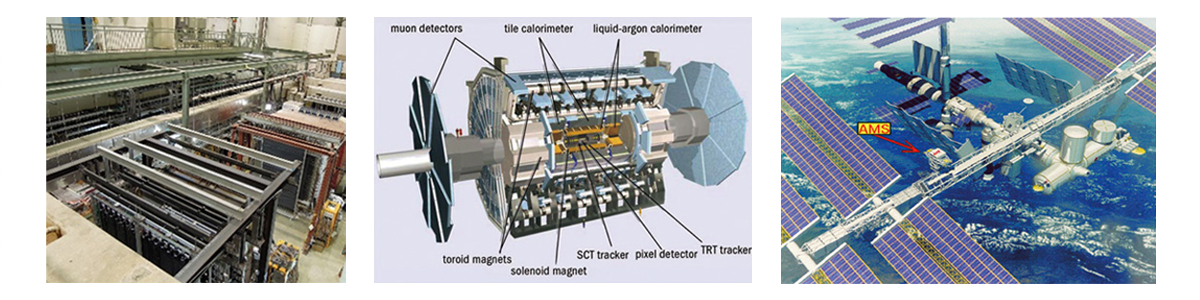
The goal of the AMS experiment is to build the first precision magnetic spectrometer to be placed on the International Space Station in 2009 to search for anti-matter and dark matter in the Universe and to study cosmic ray physics and other exotic phenomenon. A simplified detector successfully operated on board the space shuttle Discovery for 10 days in June 1998, already producing important results. The AS group is leading the Taiwan participation in AMS, which includes the construction of the superconducting magnet, electronics and computing systems, as well as simulation and analysis.
![]() |
1. AMS at the International Space Station |
![]() |
2. Schematic drawing of the AMS Detector. |
(C) Neutrino and astro-particle physics
The group was started in 1997 with the goal of pursuing an experimental program in neutrino and astro-particle physics in Taiwan. The TEXONO Collaboration, at present 40-member strong, has been built up, under the leadership of the Academia Sinica group, and with the participation of several major research institutes from Mainland China. The efforts represent the first big research collaboration among scientists from Taiwan and Mainland China. The "flagship experiment" is based on scintillating crystal and solid state detectors placed near the core of Kuo-Sheng Nuclear Power Plant II at the northern coast of Taiwan to study various low-energy neutrino interactions. This is the first particle physics experiment performed in Taiwan. World-level results have been achieved in the search of neutrino magnetic moment. Our efforts and achievement have been widely covered by the international press. Various R&D projects are pursued, in further enhancing the detector techniques, in developing methods to measure trace radiopurities, in developing advanced electronic modules and in exploring the feasibilities of future experiments in areas like Dark Matter searches and the investigations of sonoluminescence.
![]() |
1. Headlines in Taiwan Journal, with the Kuo-Sheng Nuclear Power Plant. |
![]() |
2. TEXONO Collaboration Members. |
![]() |
3. The shielding and control room at the Kuo Sheng Neutrino Laboratory. |
(D) The CERN LHC ATLAS experiment
The European Laboratory of Particle Physics (CERN) is constructing the Large Hadron Collider (LHC) scheduled for commissioning in 2008. It will provide experimental usage of proton-proton collisions at center of mass energy of 14 TeV. The ATLAS detector is constructed for high energy experiment at LHC. The Academia Sinica high energy group joined the ATLAS Collaboration in September 1999. Our responsibility includes the development and construction of compact opto-packages for the optical links of the Inner Detector (PIXEL and Semi Conductor Tracker (SCT)), and the high-speed (1.6GHz) optical transmitter and receiver modules for Liquid Argon Calorimeter (LAr). A miniature opto-package (1.6mm in height) which consists of two VCSEL’s (Vertical Cavity Surface Emitting Laser) and one epitaxial Silicon PIN diode has been developed for SCT to readout the 6 million channel silicon micro-strip detector. The other responsibility for inner detectors is to provide the 12-channel VCSEL and PIN array modules for use in the readout driver (ROD) of both SCT and PIXEL. We have prepared to search for new physics by looking for Higgs and magnetic monopoles in the first data to come.
![]() |
1. Schematic drawing of the ATLAS detector. |
![]() |
2. Opto-packages mounted on the Semi-Conductor Tracker detector modules. |
(E) Grid Computing
The WLCG (Worldwide LHC Computing Grid) infrastructure is being established to store, manage and analyze the unprecedented amounts of data – tens of millions of Gigabytes per year - that will be produced by the experiments of the Large Hadron Collider, the world’s biggest particle physics accelerator at CERN.By 2008, WLCG will integrate the equivalent of over one hundred thousand of today’s PCs from over 200 institutes (in over 40 countries) into a computing and data grid system.In 2005, ASGC (Academia Sinica Grid Computing), led by Dr. Simon C. Lin, has formally become one of the 11 Tier-1 centers (the only Tier-1 in Asia) providing services, coordination and support for WLCG.ASGC has proven to be one of the most reliable Tier-1 Centers worldwide.
ASGC participates the WLCG technology development, including (1) GSTAT which is a Grid information monitoring system now widely used by over 200 WLCG institutes, (2) gLite middleware certification and testing, and (3) distributed analysis tools for LHC. In addition, ASGC also leads in the development of important Grid technologies such as Grid Application Platform (GAP) and the interoperability of two major Grid storage systems: SRM and SRB.
Based on the experiences of WLCG, ASGC joins the European Union e-Science flagship project (Enabling Grid for E-sciencE, EGEE) providing grid services to scientists from various domains.As the Asia Federation Coordinator, ASGC is helping 9 Asian countries to participate the EGEE activities, especially, the application area.In April 2006, a collaboration of ASGC, AS Genomics Research Center and European laboratories has analyzed 300,000 possible drug candidates against the Avian Flu Virus H5N1 by using the WLCG infrastructures.Over 2000 computers were used during 4 weeks; this is equivalent to 137 years on a single computer.This is the biggest cross-continental public collaboration project ever in drug discovery. The story was widely reported by the international media such as BBC.