Introduction
|
Academia Sinica has established the Taiwan International Graduate Program (TIGP) in collaboration with a consortium of several key research universities in Taiwan. The purpose of the program is to develop the research manpower pool in those modern multidisciplinary fields that are important in the future economical and social development and to enhance the innovative potential and academic standards of research in these and related fields. |
TIGP will offer Ph.D. programs in only selected disciplines to be agreed upon between Academia Sinica and these research universities. It is the intent of the Program to offer Ph.D. education programs only in inter-disciplinary areas in the physical sciences, applied sciences, engineering, biological and agricultural sciences, health and medical sciences, and humanities and social sciences.
Academia Sinica assumes principal oversight of the academic options of the Program, and provides the intellectual leadership, the research resources, and the research and physical facilities. Qualified faculty members of the participating research universities are involved in various programs as affiliated faculties of the Program, and participate in the teaching of courses, supervision of research, and mentoring of the international graduate students.
The TIGP Program on "Nano Science and Technology"
 Within this context, the graduate program on “Nano Science and Technology” is designed to offer specific training and research opportunities to Ph.D. students who are interested in the following areas: characterization of nanomaterials and nanostructures, new nanomaterials and structures, theoretical modeling, nanodevices engineering and nano-biotechnology. This option is a collaborative effort among the Academia Sinica, National Taiwan University and National Tsing Hua University. In accordance with these research areas, the Nano Science and Technology program is divided into three categories, namely, “Physics-oriented”, “Chemistry-oriented” and “Engineering-oriented” sub-programs. The number of total students admitted to “Nano Science and Technology” Program every year is limited to twenty. The drawing below shows the number of students that can be recruited in each sub-program. The bulk of these students are international students with reasonable proficiency in the use of the English language. However, highly qualified Taiwan students (up to 10 people) with adequate English proficiency are also considered. These students may ultimately elect to do their thesis research with affiliated faculty whose principal appointments are associated with the participating research universities.
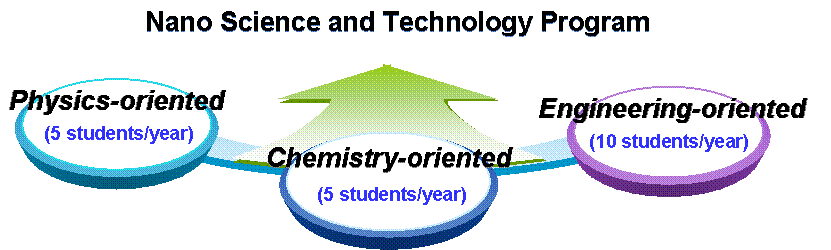
Three sub-programs and targeted number of students in a year in each sub-program
A whole array of laboratory equipment and facility for teaching and research are available within the participating units. The following is a list of some examples -- device fabrication facilities: electron beam lithography, reactive ion etching machines, ion milling machine, nanoparticle spray system. Inspection and characterization instruments: scanning electron microscope, scanning tunneling microscope, high resolution transmission electron microscope, atomic force microscope, magnetic force microscope, near-field scanning optical microscope, micro-Raman/photoluminescence microscope, ESCA/XPS/Auger spectroscopy, ultra-fast laser spectroscopy, and measurement facilities such as automatic surface plasma resonance-based biosensor, microwave instruments.
Together with the above facilities, diverse expertise, and, more importantly, close collaboration among scientists and engineers of all participating units, the present graduate program provides students with an excellent opportunity to cultivate their research interest, and to develop their creativity and skills in problem definition and problem solving.
Top